skip to content

Home

Bismillah

quran2quran3quran1

vision-top

vision-1

In the name of Allah, Most Beneficent, Most Merciful

Idarah ‘Ulum al-Qur’an

(Institute of Quranic Studies)

(Established 1984)

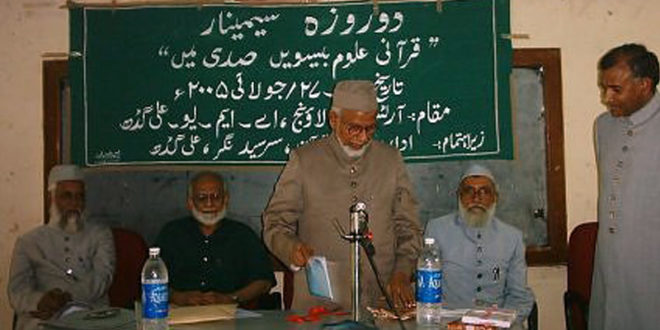
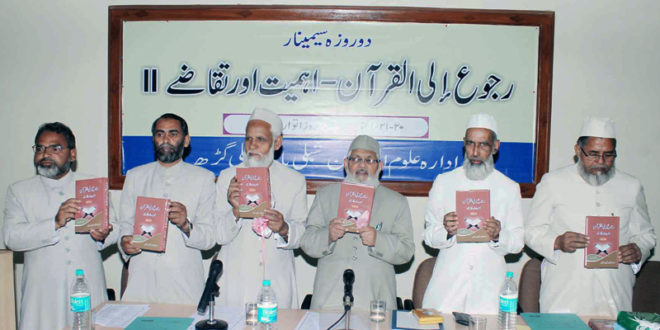
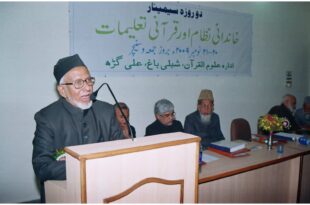
Idarah Ulum al Quran was established in 1984 by alumni of Madrasah al-Islah, Sarai Mir, Azamgarh (UP) India, based at Aligarh Muslim University, Aligarh and some other academic centers within and outside the country. It aimed at promoting research in the Qur'anic Studies, working for dissemination of its teachings and trying to find solutions for the problems facing the Muslim society in particular and the humanity at large in the light of the guidance provided by it. It would be useful to remember that Madrasah al-Islah is an institution that lays special emphasis on the study and teaching of the Noble Qur’an and it is given central place in its curricula. The methodology employed for the explanation of the Holy Qur’an and exploring its meanings and subtleties is also somewhat different from the ones generally used by the scholars working in the area of tafsir and Qur'anic studies. This methodology was developed by the renowned twentieth century scholar, exegete and reformer, Hamid al-Din Farahi (1863-1930) who, besides other things, was a great exponent of the concept of coherence (nazm) in the Qur’an. After completing his education in the traditional Islamic sciences, he joined Mohammedan Anglo-Oriental (M.A.O.) College, Aligarh, in 1891 for the acquisition of modern education and passed his B.A. in 1895. After serving a number of institutions including M.A.O., College, Aligarh, Muir College, Allahabad University and Dar al-Ulum, Hyderabad with great distinction, he finally decided to devote remaining part of his life to the study of the Noble Qur’an in accordance with the principles, which he has been able to develop through his life long ponderings over the Holy Book. During the last ten years of his life he tirelessly worked to give a concrete shape to the various aspects of his Qur'anic thought and also implement it at Madrasah al-Islah which was established in 1908 and with which he has been associated from the very beginning. He wrote extensively on the various aspects of the Qur'anics and allied subjects. He worked to revive, purify and Islamize various Islamic sciences which were greatly distorted due to their exposure to outside non-Islamic influences and long association of Muslim communities in the various parts of the world with non-Muslim societies. On these subjects he produced a vast corpus of literature. Some of it has been published while major portion of his intellectual and academic heritage is not accessible to the scholars as it is yet to be properly edited and published, since he has not been able to complete many of them in accordance with his plan. He wrote in Arabic but his disciple and intellectual heir, Amin Ahsan Islahi, has rendered some of his more important works in Urdu.

We at Idarah Ulum al-Qur’an believe that this methodology is best suited for pondering over the Holy Qur’an and best calculated to lead to the correct understanding of the meanings, subtleties, intricacies and implications of the Holy Book. Idarah Ulum al-Qur’an strives to propagate this methodology but it is not confined within its boundaries. It considers the vast literature produced by the successive generations of Mufassirun and other scholars working in the field of Qur'anic Studies as the most valued treasures of our religious and intellectual heritage and gives them equal importance without making any distinction between the various exegetic traditions which have been produced using tools of study and research approved by Islamic scholars during different periods of Islamic history. There is no place for sectarianism and fanaticism of any kind in this organisation. On the other hand, it actively strives to unite different sections of the Ummah on the basis of the principles provided by the Noble Qur’an because we believe that it can be unified only on the bedrock of the teachings of the Holy Book.

The Noble Qur’an is the last book of guidance for the humanity bestowed by the Creator of the universe upon the mankind and it contains final divine dispensation for all time to come. Importance of Qur’an for our well being in this world and salvation in the world to come, and the sense of gratefulness on our part for this great bounty of Allah, demand that our thoughts should always be conditioned by its teachings and every aspect of our life should be organised and regulated in accordance with the guidelines provided by it and in the light of principles derived from it. It is, therefore, necessary that we should remain continuously engaged in thinking and pondering over its meanings and subtleties and expounding and disseminating its teachings and precepts. It is a matter of satisfaction that Muslim community has always been conscious of this primary responsibility. But the vital importance that the Qur’an occupies for the humanity, it is imperative that our attention should always remain focussed on it, our relationship with it should be continuously refreshed and strengthened and every possible effort should be made to bring its teachings to the notice of ever larger number of people because the salvation of the humanity lies in following the precepts and principles enshrined in the Holy Qur’an.


Powered by Drupal. CrystalX theme created by Nuvio | Webdesign.